Moon’s Drishti in Vedic Astrology: Emotional Energy, Mental Peace & Relationship Psychology Explained
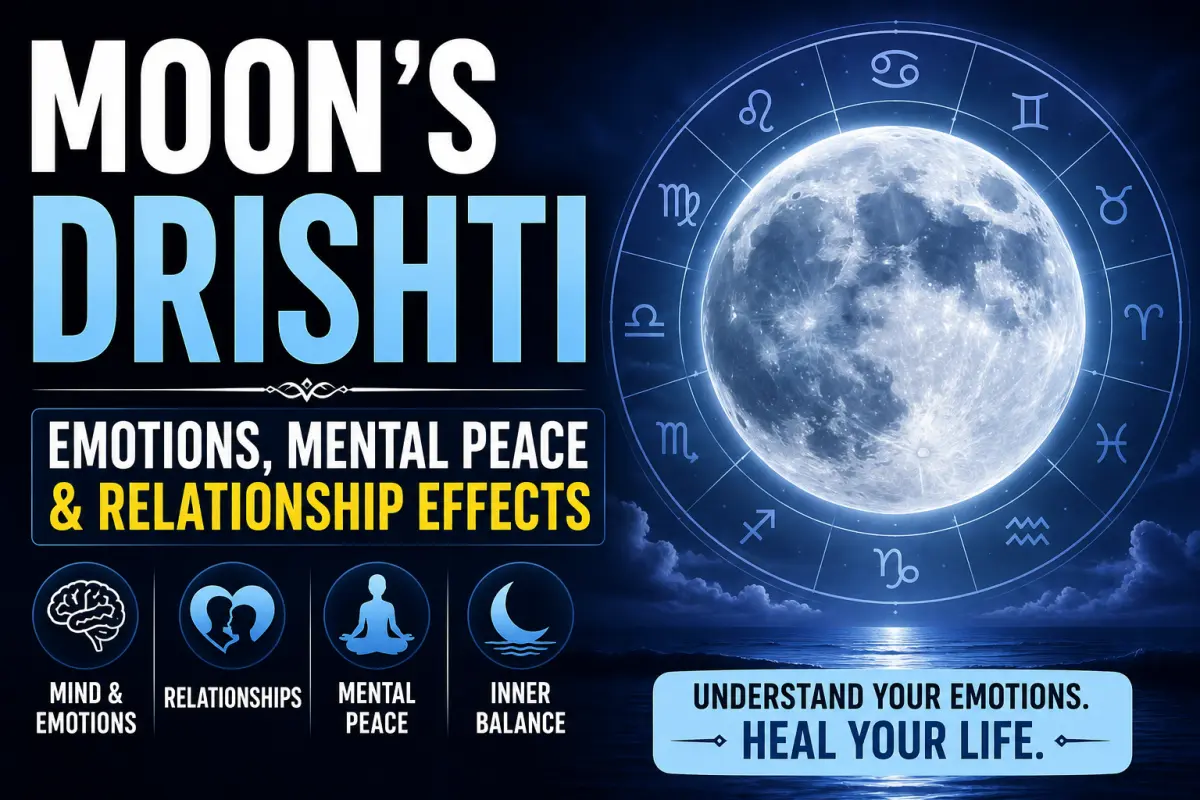
In Vedic astrology, the Moon (Chandra) is one of the most emotionally powerful planets because it governs the human mind, emotions, emotional security, imagination, intuition, mental peace, and psychological stability.
While many people focus only on Moon sign predictions, experienced astrologers also carefully analyze Moon’s drishti (aspect) because the Moon influences not only the house where it sits, but also the emotional atmosphere of the house it aspects.
Moon’s drishti reveals how a person emotionally reacts to life, relationships, stress, memories, attachment, emotional pain, and inner peace.
This article explains the emotional and psychological meaning of Moon’s drishti in Vedic astrology and provides practical astrological guidance for emotional balance and mental clarity.
What Does the Moon Represent in Vedic Astrology?
The Moon represents the emotional and psychological foundation of a person.
It governs:
You May Also Like
- Emotions
- Mental peace
- Emotional sensitivity
- Relationships and attachment
- Imagination
- Intuition
- Emotional security
- Mother energy
- Daily emotional experience
A strong Moon often creates emotionally balanced, caring, intuitive, and mentally stable individuals.
A weak or afflicted Moon may create:
- Overthinking
- Mood swings
- Anxiety
- Emotional instability
- Mental confusion
- Emotional dependency
How Moon’s Drishti Works
Like all planets, the Moon aspects the 7th house from its placement.
This means the Moon projects emotional energy toward the house opposite from where it sits.
The house receiving Moon’s drishti becomes emotionally activated.
People may develop:
- Emotional attachment
- Mental focus
- Sensitivity
- Emotional dependence
- Protective instincts
Because the Moon changes quickly, its influence often creates emotional fluctuation and psychological movement.
Psychological Meaning of Moon’s Drishti
Moon’s aspect reveals where emotional energy flows most strongly.
The aspected house often becomes connected with:
- Emotional reactions
- Mental comfort
- Inner insecurity
- Emotional memories
- Need for emotional connection
This explains why some people become emotionally attached to career, relationships, family, money, or social validation.
Moon Aspect on the 1st House
When Moon aspects the 1st house, emotions strongly influence personality.
Possible effects include:
- Emotional sensitivity
- Soft personality
- Strong intuition
- Need for emotional security
- Empathy toward others
However, emotional imbalance may also create:
- Mood swings
- Overthinking
- Emotional dependency
- Fear of rejection
These individuals often absorb emotional energy from their environment very easily.
Moon Aspect on the 4th House
The 4th house represents home, emotional comfort, mother energy, inner peace, and emotional foundation.
Moon’s influence here is usually powerful because both are naturally connected with emotions.
This aspect may create:
- Strong attachment to family
- Desire for emotional peace
- Love for home environments
- Emotional dependence on familiar people
When emotionally disturbed, individuals may struggle finding inner peace.
Moon Aspect on the 7th House
The 7th house governs relationships, marriage, partnerships, and emotional interaction.
Moon’s drishti here may create:
- Strong emotional attachment in relationships
- Need for emotional reassurance
- Romantic sensitivity
- Emotional dependence on partner behavior
This aspect often creates caring and emotionally expressive relationships.
However, emotional insecurity can also create:
- Overattachment
- Possessiveness
- Mood-based conflicts
- Fear of emotional abandonment
Moon Aspect on the 10th House
The 10th house governs career, public image, and social recognition.
When Moon aspects the 10th house, emotions strongly influence professional life.
Possible effects include:
- Career changes based on emotions
- Need for emotional satisfaction at work
- Public popularity
- Strong emotional connection with reputation
These individuals may struggle in emotionally cold or highly stressful environments.
Strong Moon vs Weak Moon Influence
| Strong Moon | Weak Moon |
|---|---|
| Emotional balance | Mental instability |
| Intuition | Overthinking |
| Compassion | Emotional insecurity |
| Inner peace | Mood swings |
| Healthy attachment | Emotional dependency |
Why Some People Overthink Constantly
Moon strongly influences mental processing and emotional memory.
More Astrology Articles
When afflicted by Saturn, Rahu, Ketu, or Mars, the Moon may create:
- Constant thinking
- Emotional fear
- Anxiety loops
- Difficulty relaxing mentally
- Sleep disturbance
People with sensitive Moon influence often replay conversations, emotional situations, and fears repeatedly in their mind.
Moon and Emotional Attachment
The Moon naturally seeks emotional security.
Because of this, Moon’s drishti may reveal where individuals become emotionally attached.
Examples:
- Moon aspect on 7th → attachment to relationships
- Moon aspect on 10th → attachment to career identity
- Moon aspect on 4th → attachment to home and comfort
Astrology teaches that emotional attachment becomes unhealthy when inner peace depends entirely on external situations.
Moon’s Drishti and Relationships
Moon strongly influences emotional compatibility.
Strong Moon energy in relationships often creates:
- Emotional bonding
- Caregiving behavior
- Empathy
- Romantic sensitivity
However, emotionally unstable Moon influence may create:
- Emotional misunderstanding
- Neediness
- Mood-based communication
- Fear of emotional rejection
Spiritual Meaning of the Moon
Spiritually, the Moon represents:
- Inner emotional consciousness
- Mental calmness
- Emotional awareness
- Compassion
- Inner reflection
A peaceful Moon creates emotional wisdom and psychological balance.
Astrological Guidance for Emotional Balance
1. Avoid Emotional Overreaction
The Moon changes quickly. Emotional reactions should not control major life decisions.
2. Build Inner Stability
External situations constantly change. Inner emotional balance is more important.
3. Reduce Overthinking
Excessive emotional analysis drains mental energy.
4. Maintain Healthy Emotional Boundaries
Empathy should not become emotional self-destruction.
5. Protect Mental Peace
The Moon becomes stronger when life contains emotional calmness and healthy routines.
Traditional Remedies for Moon Strengthening
- Meditate regularly
- Spend time near water or nature
- Maintain emotional discipline
- Sleep properly
- Chant “Om Chandraya Namah”
- Avoid emotionally toxic environments
- Practice gratitude and calm communication
Conclusion
Moon’s drishti in Vedic astrology reveals how emotional energy, mental peace, attachment, intuition, and psychological sensitivity influence different areas of life.
A strong Moon creates compassion, emotional intelligence, intuition, and inner peace, while an afflicted Moon may create anxiety, emotional instability, and overthinking.
Understanding Moon’s aspect helps reveal where emotional energy flows most strongly and how emotional balance can be developed.
Sometimes the strongest mind is not the one that thinks the most—but the one that remains calm within emotional storms.